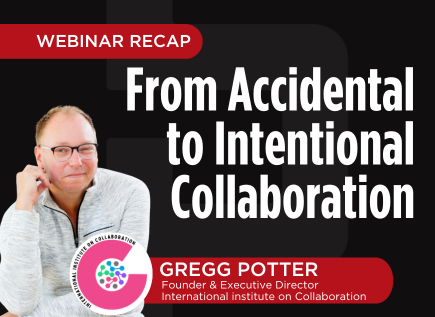
From a Park Bank webinar on March 17, 2026, featuring Gregg Potter, Founder and Executive Director of International Institute on Collaboration
Most collaborations don't start with a plan. They start with a problem, a deadline, or a shared frustration that gains momentum before anyone stops to ask who's actually doing what. That's not a failure of leadership. It's just how things tend to work. But there's a real difference between collaboration that happens to you and collaboration you build on purpose, and for nonprofits working with limited time and resources, that gap is worth closing.
That was the focus of Park Bank's recent webinar with Gregg Potter, founder and executive director of the International Institute on Collaboration. Gregg works with nonprofits, boards, and cross-functional teams to help them move from reactive partnership to something more deliberate. His core argument is simple: we already know how to collaborate. The real work is learning to do it with intention.
The Difference Between Accidental and Intentional Collaboration
Unintentional collaborations aren't bad. They're just under-designed. They form around urgency, proximity, or shared problems, and they often get things done. What they're missing is role clarity, shared expectations, and someone whose job it is to keep things moving. For nonprofits, where coalitions, funding partnerships, and community initiatives overlap constantly, the absence of that structure can drain energy from the work that matters most.
Intentional collaboration is different. Roles are clarified, expectations are discussed, and leadership is named from the start. That doesn't mean rigid or bureaucratic. It just means everyone knows why they're there and what they're working toward together.
Building Collaborative Intelligence
Gregg calls this capacity "collaborative intelligence," or CQ. It's the ability to create conditions where people can think, decide, and act better together than they could alone. And it's learnable.
CQ is made up of five building blocks: awareness of self, transformational leadership, conflict resolution, facilitation, and what Gregg calls friendliness to collaborate. Each one matters, and every person in a collaboration has room to grow in all five. Awareness of self is where everything starts. Friendliness to collaborate, perhaps the most nuanced of the five, is about approaching partnerships with genuine curiosity and respect for the other people involved, even when the work gets hard.
Conflict is Data, Not a Problem
One of the most useful ideas from the session was around conflict. Gregg's position is that conflict isn't a breakdown. It's information. It tends to show up when roles are unclear, expectations are unspoken, or power dynamics aren't being named. When you treat tension as a signal rather than a threat, it becomes one of the more honest tools a team has.
Three Practical Starting Points
For leaders working to build more intentional collaboration for nonprofits, Gregg offered three concrete moves. First, name the actors and clarify their roles: who's on the core team, who are the key players, and who is responsible for keeping things moving. Second, get everyone aligned on the objective and direction, including the smaller goals that sit inside a larger one. Third, name the tensions early, including the ones that feel too uncomfortable to bring up. Knowing where friction is likely to show up gives a team the chance to work with it rather than around it.
Getting Started
Intentional collaboration doesn't require a perfect team or a friction-free process. It requires a bit more structure than most of us start with, and the willingness to slow down long enough to put that structure in place. For nonprofits doing important work in a complicated world, that investment is worth making.
Park Bank hosts regular webinars for nonprofits, small businesses, and the broader Dane County community. To connect with our Treasury Services team, reach us at 608.278.8010.


 Park Bank