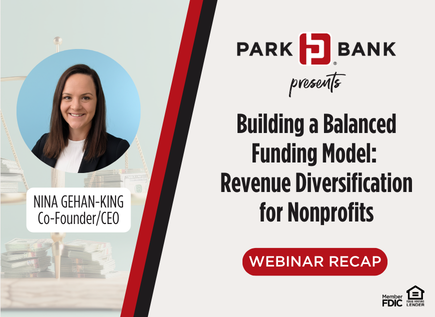
From a Park Bank webinar on February 24, 2026, featuring Nina Gehan-King, co-founder and CEO of MeaningFULL Development & Communications
If your nonprofit leans heavily on one funding source, you probably already feel the risk, even if you haven't put a name to it yet. A grant renewal that's not guaranteed. A government contract that feels shakier than it used to. That low-grade unease is worth paying attention to.
On February 24, Park Bank welcomed Nina Gehan-King to talk through what revenue diversification actually looks like in practice and how organizations can start building a more resilient funding mix without running their teams into the ground.
It's About Balance, Not a Complete Overhaul
Diversification doesn't mean walking away from government funding or replacing what's already working. It means reducing your dependence on any single source and building on what you have. Philanthropy (individuals, foundations, corporate partners) represents about 19% of overall nonprofit funding nationally — over $500 billion. For organizations willing to be strategic, there's real room to grow.
Nina's first exercise was a straightforward gut-check: write down your largest funding source, then ask what would happen if 20% of it disappeared tomorrow. Would programs get cut? Would you lose staff? The point isn't to panic. It's to get honest about where your concentration risk actually lives.
Focus, Then Build
The most practical advice Nina offered was also the simplest: pick two or three revenue streams that fit your mission and your capacity, and focus there. Individual giving, foundation grants, corporate partnerships, earned revenue, events — they're all worth considering, but not all at once. Taking on more than your team can sustain creates its own kind of risk.
Before launching anything new, look at what's already in front of you. A monthly community dinner could attract sponsorships. A donor who's given $100 every year for three years might be ready for a different kind of conversation. A few low-lift infrastructure moves — streamlining online giving, setting up a recurring gift option, keeping your Candid GuideStar profile current — can quietly make a meaningful difference without adding much to anyone's plate.
And when it comes to donors, retention and upgrades tend to deliver a better return than acquisition. The people who already believe in your work are often the best place to start.
Build Before You Need To
The organizations that weather funding disruptions best are the ones that started preparing before things got uncertain. Diversification works when it's part of your annual planning, not a reaction to something already going wrong. As Nina put it, you don't build lifeboats during a storm.
A few things worth avoiding along the way: chasing grants that don't align to your actual work, building programs around available funding rather than the other way around, and treating diversification like a crisis response with no clear ownership or measurable goals.
Year one doesn't have to be complicated. Strengthen one existing funding stream, deepen one relationship, and test one new idea. That's a real starting point, and it's a lot more sustainable than trying to do everything at once.
Park Bank hosts regular webinars for nonprofits, small businesses, and the broader Dane County community. To connect with our Treasury Services team, reach us at 608.278.8010.

 Park Bank