Park Bank has received reports that clients are receiving fraudulent phone calls impersonating the bank. We will never call you and ask for your online banking credentials. If you believe you have given out any account information, please hang up and contact our At Your Service Team immediately at 608.278.2801.
Artificial intelligence is everywhere, from the tools we use at work to the ads we see online. For many business owners and marketing leaders, AI brings a mix of curiosity, optimism, and understandable concern. Can it really save time? Will it replace people? And how do you use it responsibly without losing what makes your brand human?
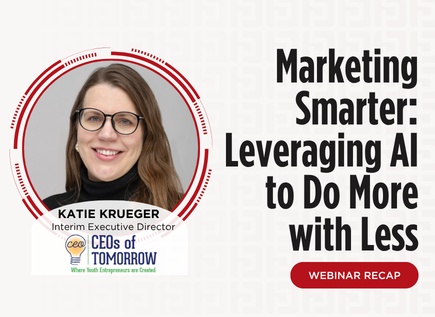
Those questions were at the center of Park Bank’s April 2026 webinar, Marketing Smarter: Leveraging AI to Do More with Less, led by Katie Kruger, Senior Lecturer at the Wisconsin School of Business and Interim Executive Director of CEOs of Tomorrow.
Rather than hype or fear, the conversation focused on something more practical. How to use AI as a tool that supports better work, clearer thinking, and stronger relationships.
AI Isn’t New, But the Way We Use It Is
While generative AI feels new, the idea behind artificial intelligence has been around for decades. The term “artificial intelligence” was coined in the 1950s, and early versions of AI have quietly supported marketing for years by helping segment audiences, recommend products, and analyze data.
What changed in recent years is accessibility. Tools like ChatGPT brought AI into everyday workflows, especially for tasks involving words, images, and data. That shift is powerful, but it also requires a reset in how we think about using these tools.
One of the most important takeaways from the webinar was this. AI works best when it’s guided by people, not when it’s left on autopilot.
Think of AI as an “Artificial Intern”
A helpful way to frame AI is to think of it as an artificial intern. It is fast, enthusiastic, and capable of handling first drafts, summaries, and repetitive tasks, but it still needs direction, oversight, and context to do good work.
AI is especially strong at generating first drafts, brainstorming ideas, summarizing large amounts of information, repurposing existing content, and spotting patterns in data. Where it falls short is just as important. AI does not understand strategy, values, or nuance on its own. It can misinterpret instructions, confidently present incorrect information, or miss the bigger picture if it is not carefully reviewed.
That is why oversight matters. Anything created with AI should be reviewed as if your name, and your reputation, are on it. Because they are.
Why “More AI” Isn’t Always Better
One surprising insight shared during the webinar is that AI does not always reduce workload. In some cases, it actually increases it. Research highlighted during the session shows that using too many AI tools can lead to mental fatigue, lower focus, and what some researchers now call “AI brain fry.”
The solution is not to avoid AI. It is to use it with intention. Limiting yourself to a few trusted tools and setting clear boundaries can help prevent burnout and keep the technology working for you, not against you.
Another risk is what was described as “mind slop.” This is content that looks polished at first glance but lacks clarity, accuracy, or purpose. Over time, relying too heavily on low quality AI output can hurt credibility and trust, especially in client facing work.
A Smarter Way Forward
When used well, AI can free up time and mental energy for the work that matters most. Strategy, decision making, storytelling, collaboration, and relationship building are all areas where people, not machines, add the greatest value.
The most effective approach is to use AI to support your work, not replace your judgment. Start small. Experiment. Review everything. Then use the time you gain to focus on the uniquely human skills that help organizations move forward with confidence.
Want the full conversation?
Watch the complete April 2026 webinar recording on YouTube:
To provide you with the best possible online experience, we sometimes partner with other organizations we trust. We refer to these organizations as "third-party vendors". Each of these vendors is required to provide us with proof they follow our stringent security protocols as a condition of our partnership. Although we perform due diligence of our vendors prior to signing agreements for their services, when you leave our website, we can not certify the privacy and security of the sites you are entering, and the content within the third-party site is solely the responsibility of the site's owner. If you have any concerns about continuing online with your request, please feel free to schedule an appointment to meet with us in person.


 Park Bank