Park Bank has received reports that clients are receiving fraudulent phone calls impersonating the bank. We will never call you and ask for your online banking credentials. If you believe you have given out any account information, please hang up and contact our At Your Service Team immediately at 608.278.2801.
What Should Nonprofits Know About Compliance and Regulatory Changes?
Park Bank
October 26, 2026
Nonprofit leaders have a lot coming at them. Changing federal priorities, funding requirements and increased scrutiny can make it difficult to know what deserves attention.
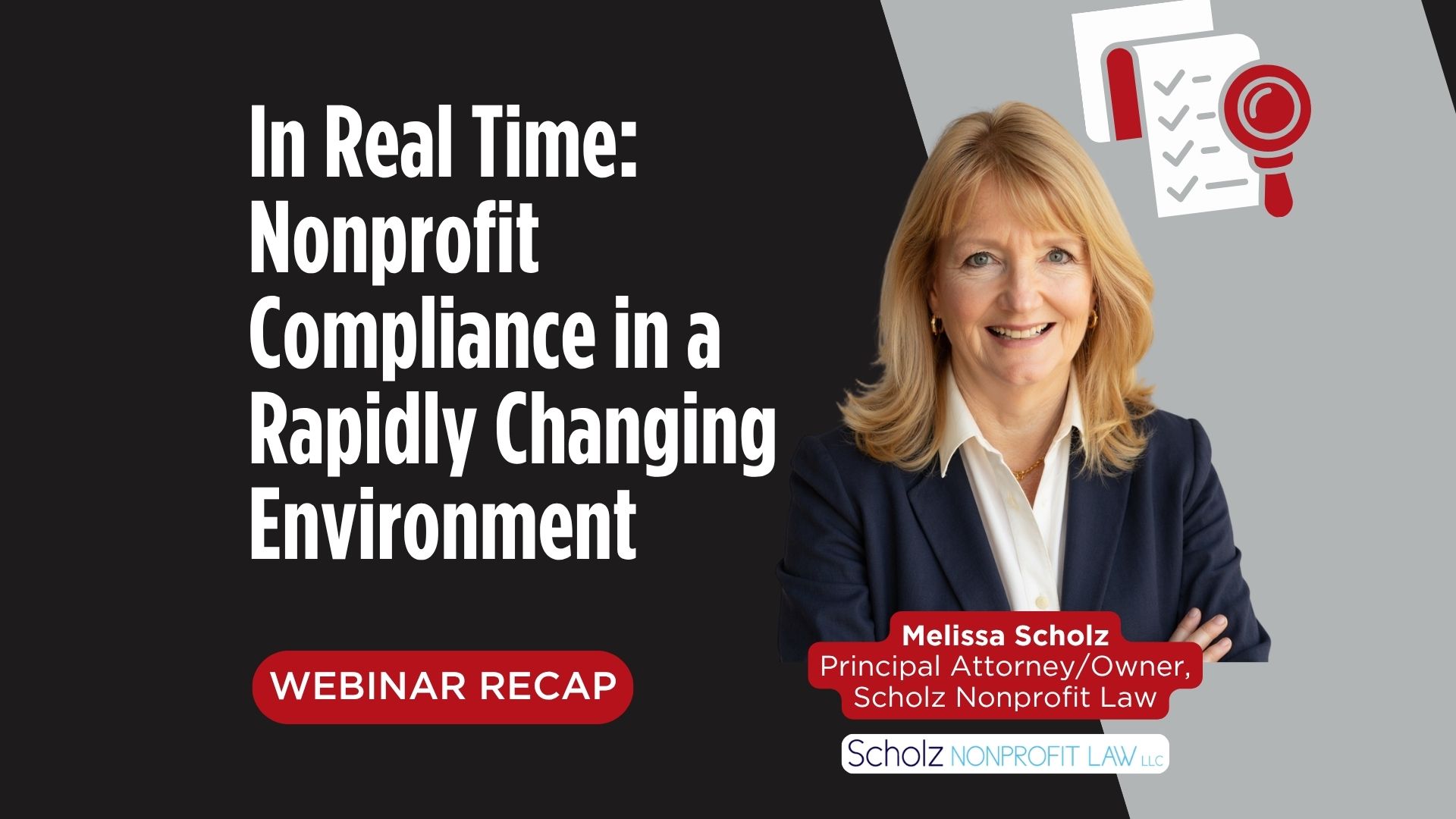
During Park Bank’s In Real Time: Nonprofit Compliance in a Rapidly Changing Environment webinar, we spoke with Melissa Schultz of Schultz Nonprofit Law about what she is seeing and what nonprofit leaders should be thinking about.
Her advice throughout the conversation was practical: keep doing the work that supports your mission, while making sure your policies, documentation and governance practices are in order.
What should nonprofits focus on right now?
According to Schultz, nonprofits should continue carrying out their missions while making sure their basic compliance practices are sound.
She encouraged organizations to pay attention to timely Form 990 filings, state filings, fundraising registrations, board meeting minutes and good governance.
For nonprofit leaders, that creates a useful starting point. Are your filings current? Are important decisions documented? Do you have appropriate policies in place? And are you consistently following them?
Taking care of those fundamentals can help avoid unnecessary compliance concerns while leadership stays focused on the organization's mission.
Does a nonprofit need a document retention policy?
Schultz recommends having a written document retention policy that is practical enough for the organization to actually follow.
Nonprofits generate a significant amount of information through email, Slack, WhatsApp, memos and other communications. Schultz encouraged leaders to think carefully about what their organizations collect, keep and eventually delete.
For small nonprofits, that doesn't necessarily mean creating a lengthy or complicated policy. Schultz cautioned that an ideal policy isn't particularly useful if an organization can't realistically follow it.
She also pointed out that Form 990 asks organizations whether they have a document retention policy.
There is one important exception to normal document practices. Schultz noted that once an organization receives notice of litigation and is subject to a litigation hold, its document practices need to change.
How should nonprofits think about DEI and program eligibility?
Schultz encouraged nonprofits to clearly articulate the problem a program is designed to address and pay close attention to how people become eligible to participate.
She discussed examples such as access to education, economic opportunity, geography and language barriers.
Her advice was to focus on the circumstances a program is intended to address rather than relying on broad shorthand to describe its purpose.
Schultz also emphasized the importance of eligibility. Organizations should examine whether race itself acts as a gateway determining who may or may not participate in a program.
Because this is an area Schultz described as receiving significant attention, nonprofits with questions about their own programs should consider getting legal guidance specific to their circumstances.
What should nonprofits receiving federal funding pay attention to?
Nonprofits receiving federal funding should closely monitor the requirements connected to their funding and distinguish between requirements already in effect and changes that have only been proposed.
During the webinar, Schultz discussed certifications, budget revisions, extensions and other requirements that organizations receiving federal funding may need to consider.
She also discussed proposed federal funding changes that had not yet taken effect at the time of the webinar.
That distinction is worth remembering. Hearing about a proposed regulation doesn't necessarily mean an organization should immediately change its practices. Organizations need to understand what currently applies to their funding and continue monitoring changes that could affect them.
How can nonprofit boards stay current on compliance issues?
Boards and executive directors should stay informed about significant changes while keeping the organization's mission at the center of their decisions.
This question came up during the webinar Q&A. For organizations without large legal or compliance teams, keeping up with changing requirements can be difficult.
Schultz recommended following reliable sources of nonprofit legal information and knowing when specialized legal guidance is needed.
She also encouraged board members to engage meaningfully in conversations about how the organization's mission can best be accomplished.
Different perspectives on risk are likely. Instead of simply defaulting to the most conservative approach, Schultz encouraged leaders to consider what will best allow the nonprofit to accomplish its mission over the long term.
To provide you with the best possible online experience, we sometimes partner with other organizations we trust. We refer to these organizations as "third-party vendors". Each of these vendors is required to provide us with proof they follow our stringent security protocols as a condition of our partnership. Although we perform due diligence of our vendors prior to signing agreements for their services, when you leave our website, we can not certify the privacy and security of the sites you are entering, and the content within the third-party site is solely the responsibility of the site's owner. If you have any concerns about continuing online with your request, please feel free to schedule an appointment to meet with us in person.


 Park Bank